As an introductory class included under mathematics, studying this subject helped me develop analytical thinking, problem-solving, and organizational skills by teaching me how to manage financial information systematically. Understanding basic accounting principles enables the interpretation of financial data, the preparation of budgets, and assessment of financial performance. Since it integrates well with mathematics, this course enhanced my numeracy skills and introduced practical applications of mathematical concepts in real-world scenarios.
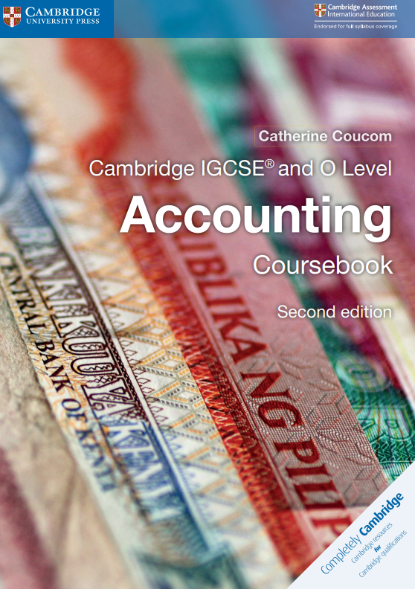
By studying with the Cambridge IGCSE Accounting Coursebook, I was not only learning core accounting principles but also applying them to practical exercises, which made the learning experience engaging. Each session introduced me to a new skill, whether it was interpreting financial statements, balancing accounts, or budgeting. I found it exciting to see how mathematics connects directly to real-life financial tasks. This hands-on approach helped me better understand the concepts and kept me motivated.
The accounting coursebook’s chapters were : Business documents, Books of prime entry, Financial statements Part A, Financial statements Part B, Accounting rules, Other payables and other receivables, Accounting for depreciation and disposal of non-current assets, and Irrecoverable debts and provisions for doubtful debts. All these accounting techniques were connected to real-world business situations. I now understand how financial decisions are recorded and how important accurate bookkeeping is for managing a business.